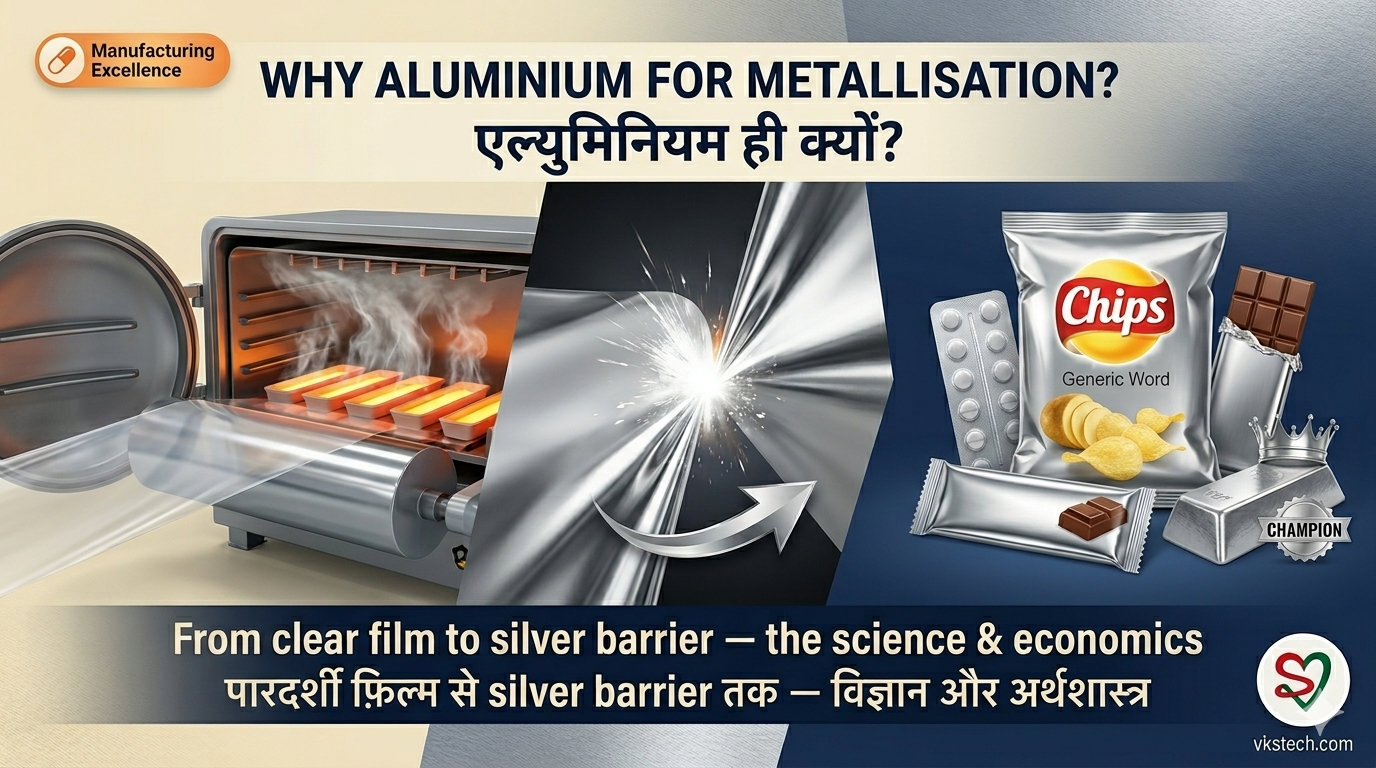
🔬 Why Aluminium for Metallisation? The 7 Metals We Could Use — And Why We Don't
Walk into any flexible packaging plant and ask why we metallise with aluminium. Most operators will say "because that's what we've always used." Most engineers will say "because it's cheap." Both answers are incomplete. The real answer is a 90-year story of physics, chemistry, economics, and food safety — and the result is one of the most carefully optimised material choices in modern manufacturing. Aluminium is not the cheapest metal, not the shiniest, not the most conductive. But across the 7 metrics that matter for packaging, no other metal comes close.
This blog breaks down why aluminium is the overwhelmingly dominant choice for metallised packaging globally — from chips packets to pharmaceutical blisters to cigarette foils. We will compare aluminium against 7 alternative metals that theoretically could replace it, explain the physics of why each alternative fails, and show where specialty metals like silver and copper DO win in niche applications. All reference prices are from April 2026 market data (LME and Indian bullion benchmarks) and are date-stamped accordingly. These absolute prices fluctuate daily — so we also show the cost ratios vs aluminium, which stay broadly stable over decades. If you have ever wondered what makes aluminium special, or why your customer specifies aluminium only, this is the complete answer.
🎯 The 7 Things a Packaging Metal Must Do
Before comparing metals, understand what a packaging metallisation layer must achieve. Flexible packaging is not a lab experiment — it is a product that must survive factory runs at 800 m/min, transport across oceans, retail shelf life of 12-18 months, and direct food contact. The metallic layer must deliver all seven requirements simultaneously.
| Requirement | What It Means | Why It Matters |
|---|---|---|
| 1. Barrier Performance | Block oxygen, moisture, light, aroma | Product shelf life 6× longer |
| 2. Low Evaporation Temperature | Easy to vaporise in vacuum chamber | Lower energy cost, faster production |
| 3. Good Adhesion to PET/BOPP | Stays bonded to the base film | Survives lamination, printing, bending |
| 4. Food-Grade Safety | Non-toxic, no migration into food | Regulatory approval in all markets |
| 5. Low Raw Material Cost | Affordable for mass consumer products | Must work in ₹5 chips packet economics |
| 6. Chemical Stability | No reaction with food acids, oils, moisture | No corrosion, no taste/odour change |
| 7. Recyclability | Compatible with recycling streams | Modern EPR regulations worldwide |
The challenge: No single "cheap and easy" property is enough. A metal must score well on all seven. Aluminium happens to be the only metal that scores well on all seven. That is the entire secret.
⚙️ How Vacuum Metallisation Actually Works
Before comparing metals, understand the process constraint. Vacuum metallisation is not electroplating. In a metalliser machine, the film runs over a chilled drum inside a vacuum chamber. Below the drum, ceramic boats glow red-hot (around 1400-1600°C), and solid metal wire is fed into these boats. The metal melts, then vaporises, and the metal vapour travels upward to coat the moving film.
This process places a hard physics constraint on which metals can even be candidates: the metal must vaporise at a temperature the equipment can handle. Metals with very high boiling points (tungsten at 5,555°C, carbon at 4,827°C) simply cannot be evaporated with industrial equipment. This alone eliminates most of the periodic table before we even discuss cost.
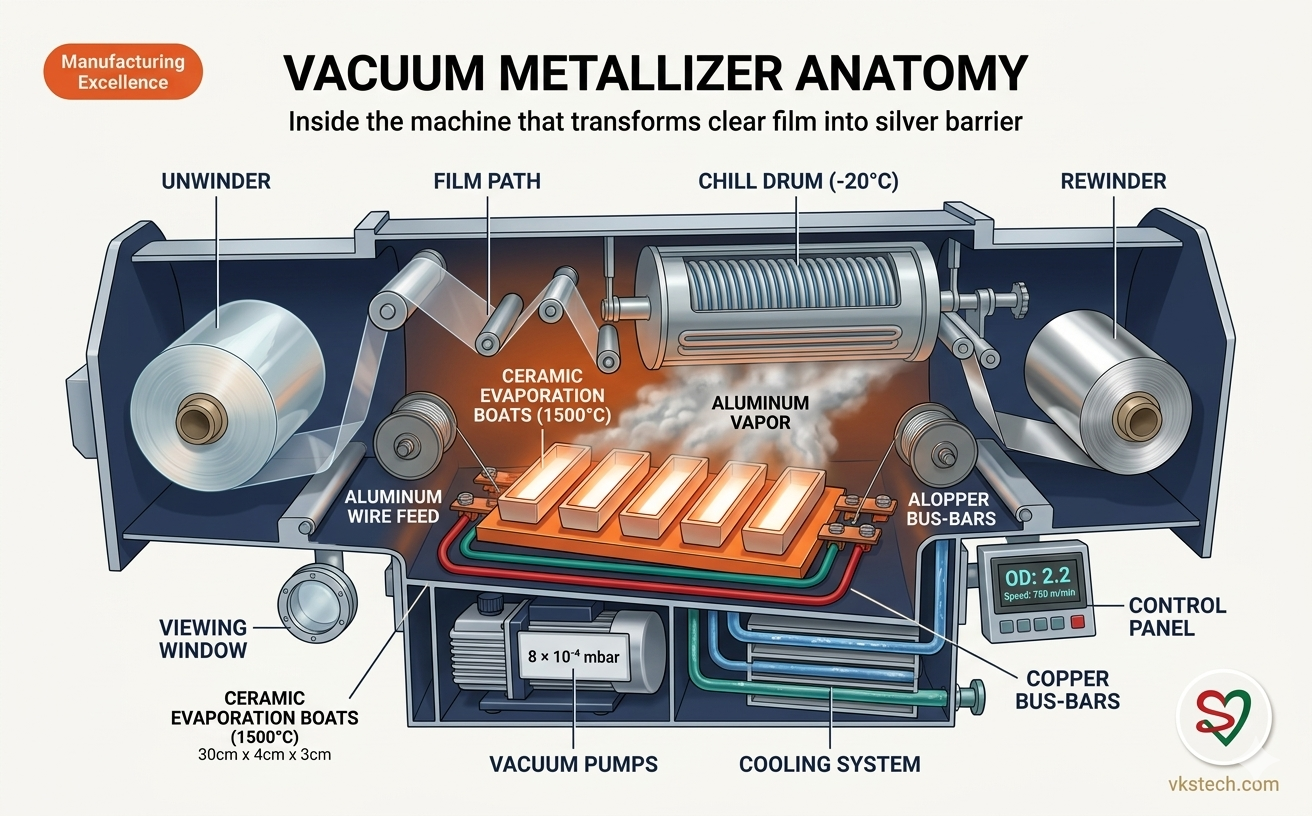
The metallisation process happens in 5 distinct stages, each critical for quality output. A single interruption at any stage can compromise the entire batch of film. This is why metalliser operators follow strict SOPs for every shift.
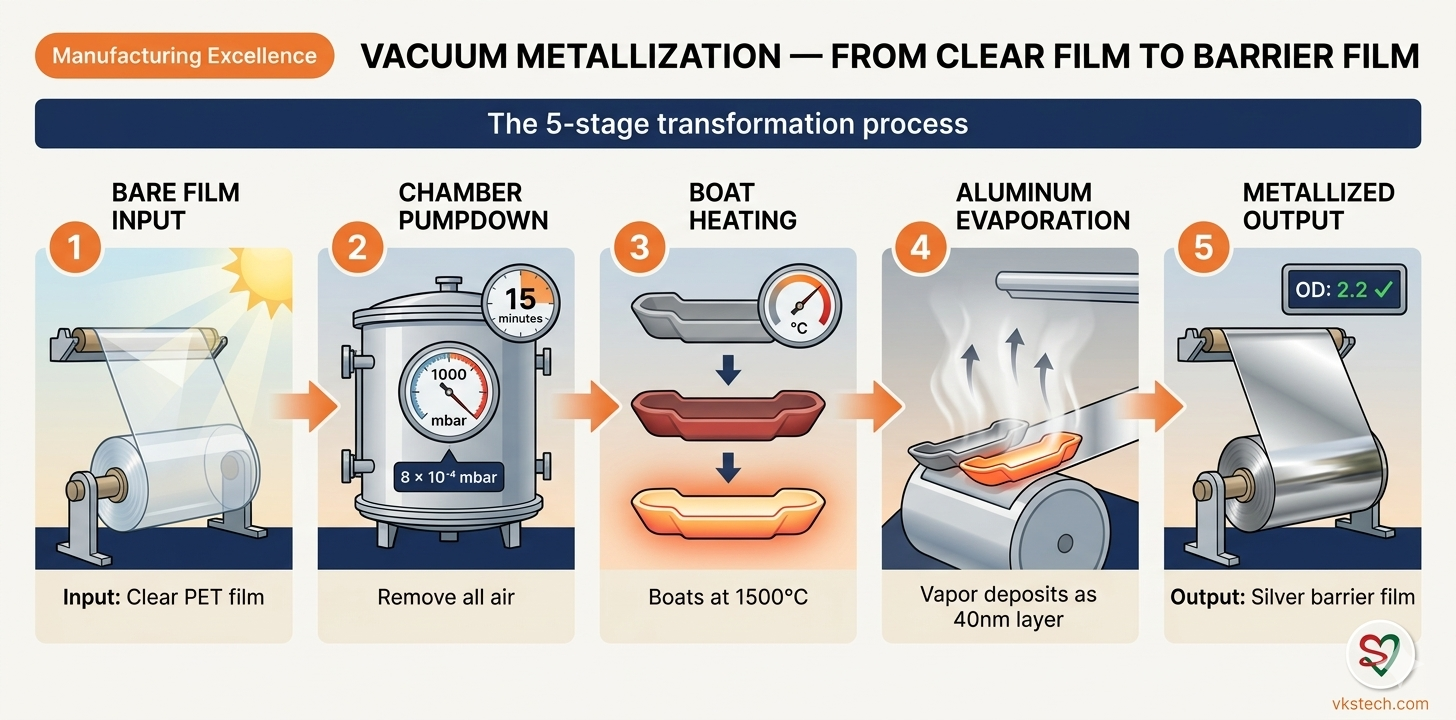
Understanding these 5 stages is important because it reveals another reason aluminium dominates: the entire process is optimised for aluminium's specific properties. Ceramic evaporation boats, wire feed systems, vacuum levels, and drum temperatures — all designed around aluminium. Switching to a different metal would require rebuilding the entire equipment ecosystem.
🥇 The 8-Metal Comparison — Aluminium Against All Contenders
Here is every metal that could theoretically be used for food packaging metallisation. The first column shows why aluminium dominates. The next seven columns show why each alternative has been tested, considered, and largely rejected.
| Metal | Boiling Point | Cost (reference) | vs Aluminium | Barrier | Food Safety | Industry Status |
|---|---|---|---|---|---|---|
| Aluminium (Al) | 2,470°C | ~₹380/kg | 1× (baseline) | Excellent | GRAS approved globally | Industry standard |
| Silver (Ag) | 2,162°C | ~₹2,60,000/kg | ~680× more | Excellent | Safe, but over-kill | Luxury applications only |
| Copper (Cu) | 2,562°C | ~₹1,250/kg | ~4× more | Good | Reacts with food acids | Decorative, non-food use |
| Gold (Au) | 2,856°C | ~₹1.53 crore/kg | ~40,000× more | Excellent | Inert, safe | Cosmetic/luxury foils only |
| Zinc (Zn) | 907°C | ~₹300/kg | ~0.8× (similar) | Moderate | Toxicity at high intake | Rarely used for food |
| Tin (Sn) | 2,602°C | ~₹3,000/kg | ~8× more | Good | Safe (historic use) | Replaced by Al decades ago |
| Chromium (Cr) | 2,671°C | ~₹400/kg | ~1× | Excellent | Cr(VI) is carcinogenic | Banned in food contact |
| Nickel (Ni) | 2,913°C | ~₹1,700/kg | ~5× more | Good | Allergen risk | Industrial only, not food |
📅 Prices verified: April 2026, sourced from Indian market benchmarks (MCX, NALCO P1020 ingot, Hindalco, BALCO, Delhi NCR/Mumbai spot), LME (London Metal Exchange), and Indian bullion markets. Absolute Rupee values fluctuate daily — but the cost ratios between metals stay broadly consistent across decades. The "vs Aluminium" column is the insight that matters long-term. Boiling points are standard physical constants and do not change. For current spot prices, check MCX, NALCO, or your local market.
Look at the highlighted row. Aluminium wins by being simultaneously affordable, safe, well-bonding, and having a workable boiling point. The next closest all-rounder is tin, which aluminium displaced in the mid-20th century for one simple reason: aluminium is roughly 9× cheaper per kilogram.
💰 The Cost Story — Why Relative Price Ratios Matter
The price difference between metals is not 2× or 5× — it ranges from roughly equal cost to tens of thousands of times more expensive. When a metal costs hundreds or thousands of times more than aluminium, economics alone rules it out for mass packaging:
| Metal | Price per kg (reference) | Cost Ratio vs Aluminium | Viable for Mass Packaging? |
|---|---|---|---|
| Aluminium | ~₹380/kg | 1× (baseline) | Yes — ideal |
| Zinc | ~₹300/kg | ~0.8× (similar cost) | Cost OK but toxicity concern |
| Chromium | ~₹400/kg | ~1× | Cost OK but Cr(VI) carcinogenic |
| Copper | ~₹1,250/kg | ~4× more expensive | Wasteful; reacts with acids |
| Nickel | ~₹1,700/kg | ~5× more expensive | Not food-safe (allergen) |
| Tin | ~₹3,000/kg | ~8× more expensive | Marginal for premium only |
| Silver | ~₹2,60,000/kg | ~680× more expensive | No — destroys mass economics |
| Gold | ~₹1.53 crore/kg | ~40,000× more expensive | Absolutely not |
📅 Reference prices verified: April 2026, sourced from LME and Indian bullion market benchmarks. Absolute values change daily with commodity markets; the cost ratios between metals remain the stable, decision-relevant insight across decades.
These ratios tell the full economic story. For a mass-market chip packet costing ₹10 to the consumer, even the tiny amount of metal needed for metallisation has to fit within a few paise of raw material budget. At ~8× the cost of aluminium, tin becomes marginal. At ~680× the cost, silver is economically impossible for mass products. At ~40,000× the cost, gold is absurd except for luxury aesthetic products where the customer specifically pays for the gold colour.
The insight: The exact per-packet rupee cost is less important than the ratio. Silver being ~680× more expensive than aluminium means a plant switching from aluminium to silver would see its metal raw material cost rise by roughly 68,000%. No FMCG company can absorb that cost for zero measurable barrier improvement. Economics, not physics, is why aluminium won — and why aluminium will keep winning.
🔬 The Physics of "Good Enough" — Why Aluminium's Barrier is Already Maximum
Here is the beautiful technical insight that explains everything: once a metal layer is 40 nanometres thick or more, it is essentially opaque to light, oxygen, and moisture. Doubling the thickness does not double the barrier. Using a more premium metal does not improve the barrier. The barrier is already at its physical maximum.
This means:
- Aluminium at 40nm blocks 99.9% of oxygen, light, and moisture
- Silver at 40nm blocks 99.9% of oxygen, light, and moisture
- Gold at 40nm blocks 99.9% of oxygen, light, and moisture
The barrier quality of aluminium is physically indistinguishable from silver or gold at the same thickness. So why pay hundreds of times more for silver, or tens of thousands of times more for gold? You only pay extra if you need an aesthetic quality (like a metallic gold shimmer for perfume packaging), not for barrier performance.

🏭 Where Other Metals DO Win — The Niche Applications
Aluminium is not universal. Specific markets use specific metals for specific reasons. Understanding these niches helps you advise customers correctly.
| Metal | Niche Application | Why Not Aluminium? |
|---|---|---|
| Silver | Luxury cosmetics, antimicrobial food wraps | Silver has natural antibacterial property; aluminium does not |
| Gold | Premium chocolate wrappers, high-end perfume | Aesthetic only — customer pays for gold colour/prestige |
| Copper | Decorative gift wrap, RFID shielding films | Copper has distinct rose-gold colour; electrical properties |
| Chromium | Industrial / electronic packaging (non-food) | Used where Cr safety restrictions don't apply |
| Zinc | Rust-proofing films for metal product packaging | Zinc sacrificial anode properties for corrosion protection |
| Al + Oxide (AlOx) | Transparent high-barrier retort pouches, solar packaging | When customers need to SEE the product inside |
The AlOx case is especially interesting. When a customer wants transparent packaging (like a clear retort pouch for ready-to-eat meals), pure aluminium will not work — it is opaque silver. The solution is aluminium oxide, which provides 90% of aluminium's barrier while being transparent. This is why AlOx has become a growing niche in premium flexible packaging.
🌍 The Sustainability Angle — Why Aluminium Will Stay Dominant
Modern packaging must answer one more question: what happens after use? Extended Producer Responsibility (EPR) regulations in India, EU, and emerging markets increasingly penalise unrecyclable packaging. This is where aluminium's position is actually strengthening:
- Aluminium is infinitely recyclable — it can be melted and reused without property loss
- Aluminium recycling uses 95% less energy than producing virgin aluminium
- The metallised layer is so thin (typically 20-40nm) that it contributes a very small fraction of total packet weight
- Plastic-aluminium separation technology is maturing rapidly in recycling facilities
Compare this to emerging metallisation alternatives like silicon oxide (SiOx) — which offer similar barrier but require more expensive processes. Aluminium's combination of recyclability, low energy footprint, and established infrastructure gives it a sustainability advantage that is difficult to displace.
🎓 Common Questions from Engineers and Students
Q1: Why is the aluminium layer so thin (40nm)? Can't we make it thicker for better barrier?
The 40nm thickness is already at the point of diminishing returns. Going thicker wastes aluminium (cost), reduces flexibility (film may crack at bends), and increases environmental burden. 40nm is the engineering sweet spot.
Q2: What is the difference between metallised film and aluminium foil?
Aluminium foil is typically 9-20 micrometres (9,000-20,000 nanometres) thick — about 500× thicker than metallised film. Foil is self-supporting metal; metallised film is a plastic substrate with a vapour-deposited metal layer. Foil is used for yoghurt lids, confectionery; metallised film is used for chips, biscuits, laminate pouches.
Q3: Why do some plants use two-layer aluminium (double metallised)?
For specialty high-barrier applications (pharma, ultra-long shelf life products), a second metallisation pass adds redundancy against pinholes. Pinholes are microscopic defects in the metal layer. A second layer covers the first layer's pinholes, reducing the effective pinhole density from 1 per cm² to near zero.
Q4: Is aluminium safe for direct food contact?
Yes, when used within regulatory specifications. The aluminium layer is typically NOT in direct food contact — it is laminated between plastic layers. Modern packaging uses the structure [outer printable layer]-[aluminium]-[inner sealant layer]. The sealant layer (PE, PP) is what touches the food.
🛡️ Quick Reference — When to Specify Which Metal
- Default choice for standard flexible packaging: Aluminium
- Transparent packaging with barrier: Aluminium Oxide (AlOx) or Silicon Oxide (SiOx)
- Premium visual/luxury: Gold (cosmetic), Silver (premium food)
- Antimicrobial requirement: Silver (medical, specialty food)
- Non-food decorative: Copper, mixed metallic inks
- Electronic/industrial: Chromium, Nickel (shielding applications)
- Retort pouches visible food: AlOx for transparency + barrier

📥 Free Downloads — Reference Materials
Three professional reference documents from VKS Tech — for engineers, procurement, and students.
- Complete Metals Comparison Chart — A3 infographic, all 8 metals across 12 properties
- Metallisation Fundamentals Guide — Technical primer for new engineers
- Material Selection Flowchart — Quick decision tree for procurement
🔬 Metallisation के लिए Aluminium क्यों? — 7 Metals जो Replace कर सकते थे, लेकिन नहीं कर पाए
किसी भी flexible packaging plant में जाओ और पूछो कि हम aluminium से metallise क्यों करते हैं। ज़्यादातर operators कहेंगे "क्योंकि हमेशा से यही use होता आया है।" ज़्यादातर engineers कहेंगे "क्योंकि सस्ता है।" दोनों जवाब अधूरे हैं। असली जवाब 90 साल की कहानी है — physics, chemistry, economics, और food safety की। और नतीजा है modern manufacturing का एक सबसे carefully optimised material choice। Aluminium न ही सबसे सस्ता metal है, न सबसे shiny, न सबसे conductive। लेकिन packaging के लिए ज़रूरी 7 metrics में — कोई दूसरा metal aluminium के आसपास भी नहीं है।
ये blog explain करती है कि क्यों दुनिया की ज़्यादातर metallised packaging में aluminium ही use होता है — चिप्स पैकेट से pharmaceutical blisters से cigarette foils तक। हम aluminium की तुलना 7 alternative metals से करेंगे जो theoretically replace कर सकते थे। हर alternative क्यों fail हुआ — इसकी physics समझेंगे। और जहाँ silver, copper जैसे specialty metals actually जीतते हैं — वो niche applications भी देखेंगे। सभी reference prices April 2026 के market data से हैं (LME और Indian bullion benchmarks) और date-stamped हैं। ये absolute prices रोज़ fluctuate होते हैं — इसलिए हम साथ में Aluminium से cost ratios भी दिखाते हैं, जो दशकों तक broadly stable रहते हैं। अगर आपने कभी सोचा है कि aluminium में क्या खास है, या आपका customer "aluminium only" क्यों specify करता है — तो ये पूरा जवाब है।
🎯 Packaging Metal की 7 ज़रूरतें
Metals compare करने से पहले, ये समझो कि packaging metallisation layer को क्या-क्या करना होता है। Flexible packaging कोई lab experiment नहीं — ये एक product है जिसे factory में 800 m/min पर survive करना है, समुद्र पार transport होना है, 12-18 महीने की retail shelf life झेलनी है, और food के direct contact में आना है। Metallic layer को ये सातों requirements एक साथ पूरी करनी हैं।
| Requirement | मतलब क्या | क्यों ज़रूरी |
|---|---|---|
| 1. Barrier Performance | Oxygen, moisture, light, aroma रोकना | Shelf life 6× ज़्यादा |
| 2. Low Evaporation Temperature | Vacuum chamber में आसानी से vaporise हो | कम energy cost, तेज़ production |
| 3. PET/BOPP पे अच्छा Adhesion | Base film से bond बना रहे | Lamination, printing, bending में टिके |
| 4. Food-Grade Safety | Non-toxic, food में migrate न हो | सभी markets में regulatory approval |
| 5. Raw Material Cost कम | Mass consumer products के लिए affordable | ₹5 chips packet की economics में fit हो |
| 6. Chemical Stability | Food acids, oils, moisture से react न करे | Corrosion नहीं, taste/smell change नहीं |
| 7. Recyclability | Recycling streams compatible हो | दुनियाभर की EPR regulations |
Challenge ये है: कोई एक "cheap and easy" property enough नहीं है। Metal को सातों पे अच्छा score करना है। Aluminium ही एकमात्र metal है जो सातों पे अच्छा score करता है। यही पूरा राज़ है।
⚙️ Vacuum Metallisation actually कैसे काम करता है
Metals compare करने से पहले, process की constraint समझो। Vacuum metallisation electroplating नहीं है। Metalliser machine में film vacuum chamber के अंदर एक chilled drum पे चलती है। Drum के नीचे ceramic boats lal-गरम होते हैं (लगभग 1400-1600°C) और solid metal wire इन boats में feed होती है। Metal पिघलता है, फिर vaporise होता है, और metal vapour ऊपर जाकर चलती film को coat करता है।
इस process की एक hard physics constraint है कि कौन सा metal candidate भी बन सकता है: Metal का vaporisation temperature equipment handle कर पाए। बहुत high boiling point वाले metals (Tungsten 5,555°C, Carbon 4,827°C) industrial equipment से evaporate ही नहीं हो सकते। Cost की बात करने से पहले ही इससे periodic table के ज़्यादातर metals बाहर हो जाते हैं।
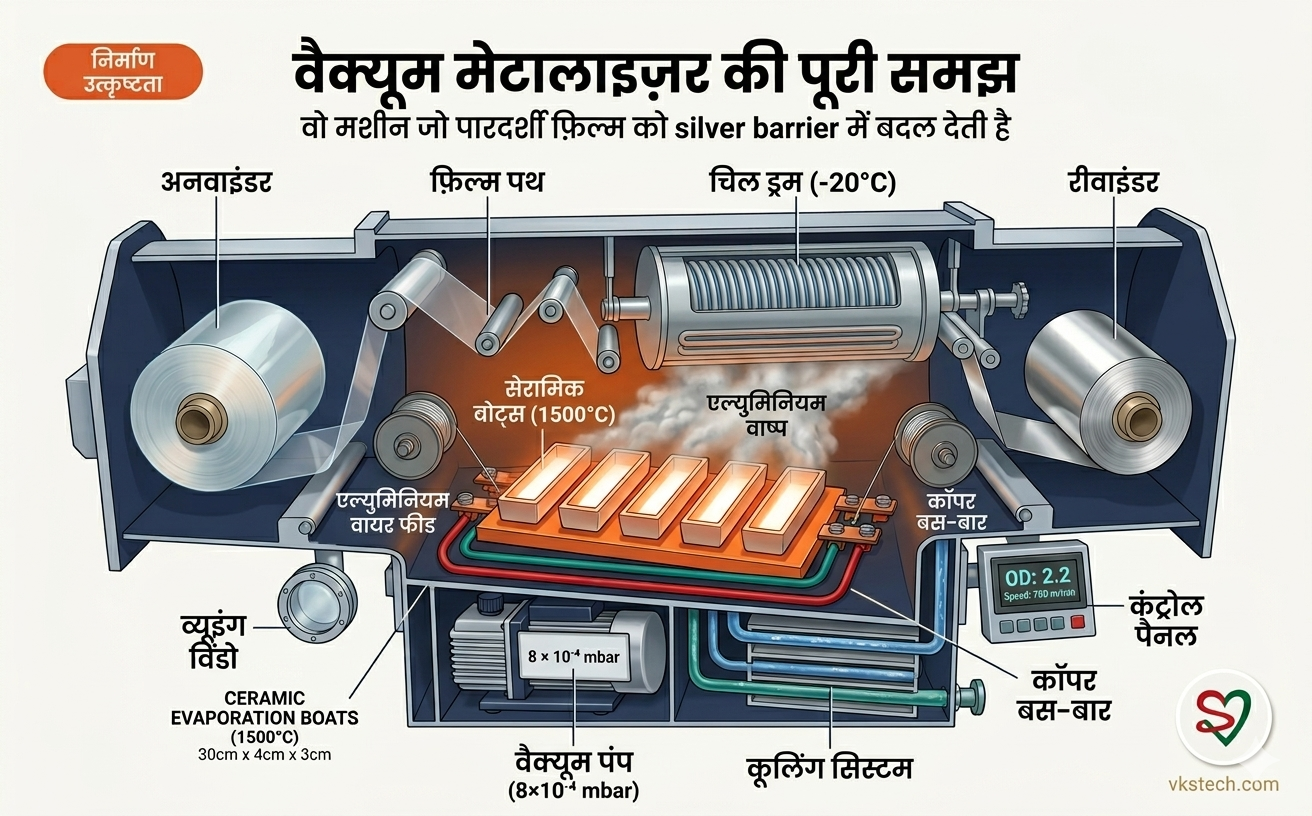
Metallisation process 5 अलग stages में होती है, हर stage quality output के लिए critical है। किसी भी stage में एक interruption पूरे batch की quality compromise कर सकता है। इसीलिए metalliser operators हर shift में strict SOPs follow करते हैं।

ये 5 stages समझना इसलिए important है क्योंकि ये एक और कारण बताते हैं कि क्यों aluminium dominate करता है: पूरी process aluminium की specific properties के लिए optimised है। Ceramic evaporation boats, wire feed systems, vacuum levels, और drum temperatures — सब aluminium के लिए designed हैं। दूसरे metal पर switch करना पूरा equipment ecosystem फिर से बनाने जैसा होगा।
🥇 8-Metal Comparison — Aluminium बनाम सभी Contenders
ये है वो हर metal जो theoretically food packaging metallisation के लिए use हो सकता था। पहला row aluminium का dominance दिखाता है। बाक़ी सात rows दिखाते हैं कि हर alternative क्यों test हुआ, consider हुआ, और बड़े पैमाने पे reject हुआ।
| Metal | Boiling Point | Cost (reference) | Aluminium से | Barrier | Food Safety | Industry Status |
|---|---|---|---|---|---|---|
| Aluminium (Al) | 2,470°C | ~₹380/kg | 1× (baseline) | Excellent | दुनियाभर GRAS approved | Industry standard |
| Silver (Ag) | 2,162°C | ~₹2,60,000/kg | ~680× ज़्यादा | Excellent | Safe, लेकिन overkill | सिर्फ़ luxury applications |
| Copper (Cu) | 2,562°C | ~₹1,250/kg | ~4× ज़्यादा | Good | Food acids से react करता है | Decorative, non-food use |
| Gold (Au) | 2,856°C | ~₹1.53 करोड़/kg | ~40,000× ज़्यादा | Excellent | Inert, safe | सिर्फ़ cosmetic/luxury foils |
| Zinc (Zn) | 907°C | ~₹300/kg | ~0.8× (समान) | Moderate | High intake पर toxic | Food के लिए बहुत कम |
| Tin (Sn) | 2,602°C | ~₹3,000/kg | ~8× ज़्यादा | Good | Safe (historic use) | दशकों पहले Al ने replace किया |
| Chromium (Cr) | 2,671°C | ~₹400/kg | ~1× | Excellent | Cr(VI) carcinogenic | Food contact में banned |
| Nickel (Ni) | 2,913°C | ~₹1,700/kg | ~5× ज़्यादा | Good | Allergen risk | सिर्फ़ industrial, food नहीं |
📅 Prices verified: April 2026 में, Indian market benchmarks (MCX, NALCO P1020 ingot, Hindalco, BALCO, Delhi NCR/Mumbai spot), LME (London Metal Exchange), और Indian bullion markets से। Absolute Rupee values रोज़ fluctuate होते हैं — लेकिन metals के बीच cost ratios दशकों तक broadly consistent रहते हैं। "Aluminium से" column ही वो insight है जो long-term में matter करती है। Boiling points standard physical constants हैं। Current spot prices के लिए MCX, NALCO, या local market check करो।
Highlighted row देखो। Aluminium एक साथ affordable, safe, अच्छे bond वाला, और workable boiling point वाला है — इसी कारण जीतता है। दूसरा सबसे close all-rounder है tin — जिसे aluminium ने 20वीं सदी के मध्य में displace किया। Reason simple: aluminium 10× सस्ता है per kilogram।
💰 Cost की कहानी — Relative Price Ratios क्यों Matter करते हैं
Metals के बीच price difference 2× या 5× का नहीं है — लगभग बराबर cost से लेकर दसियों हज़ार गुना ज़्यादा तक होता है। जब कोई metal aluminium से सैकड़ों या हज़ारों गुना ज़्यादा महँगा हो — तो economics अकेले ही उसे mass packaging से बाहर कर देती है:
| Metal | Price per kg (reference) | Aluminium से Cost Ratio | Mass Packaging के लिए viable? |
|---|---|---|---|
| Aluminium | ~₹380/kg | 1× (baseline) | हाँ — ideal |
| Zinc | ~₹300/kg | ~0.8× (लगभग बराबर cost) | Cost OK लेकिन toxicity concern |
| Chromium | ~₹400/kg | ~1× | Cost OK लेकिन Cr(VI) carcinogenic |
| Copper | ~₹1,250/kg | ~4× ज़्यादा महँगा | Wasteful; acids से react |
| Nickel | ~₹1,700/kg | ~5× ज़्यादा महँगा | Food-safe नहीं (allergen) |
| Tin | ~₹3,000/kg | ~8× ज़्यादा महँगा | Sirf premium के लिए marginal |
| Silver | ~₹2,60,000/kg | ~680× ज़्यादा महँगा | नहीं — mass economics ख़त्म |
| Gold | ~₹1.53 करोड़/kg | ~40,000× ज़्यादा महँगा | बिलकुल नहीं |
📅 Reference prices verified: April 2026 में LME और Indian bullion market benchmarks से। Absolute values commodity markets के साथ रोज़ बदलते हैं; metals के बीच cost ratios ही वो stable, decision-relevant insight है जो दशकों तक valid रहती है।
ये ratios पूरी economic कहानी बताते हैं। Mass-market chip packet जिसकी consumer price ₹10 है — उसमें metallisation के लिए raw material budget बहुत कम पैसों में fit होना चाहिए। Aluminium से 9× cost पर tin marginal हो जाता है। 680× cost पर silver mass products के लिए economically impossible है। 45,000× cost पर gold absurd है — except luxury aesthetic products के लिए जहाँ customer specifically gold colour के लिए pay करता है।
Insight: Exact per-packet rupee cost से ज़्यादा important है ratio। Silver aluminium से ~680× ज़्यादा महँगा है — मतलब कोई plant aluminium से silver पर switch करे, तो metal raw material cost roughly 68,000% बढ़ जाएगी। कोई FMCG company ये cost absorb नहीं कर सकती — वो भी zero measurable barrier improvement के लिए। Physics नहीं, Economics ने aluminium को जिताया — और आगे भी जिताती रहेगी।
🔬 "Good Enough" की Physics — Aluminium का Barrier पहले से Maximum क्यों है
ये beautiful technical insight है जो सब कुछ explain करता है: एक metal layer जब 40 nanometres या उससे ज़्यादा मोटी हो जाती है, तब वो practically light, oxygen, moisture के लिए opaque हो जाती है। Thickness double करने से barrier double नहीं होता। Premium metal use करने से barrier नहीं सुधरता। Barrier पहले से ही physical maximum पे है।
मतलब:
- 40nm पर Aluminium 99.9% oxygen, light, moisture block करता है
- 40nm पर Silver 99.9% oxygen, light, moisture block करता है
- 40nm पर Gold 99.9% oxygen, light, moisture block करता है
Aluminium की barrier quality same thickness पर silver या gold से physically indistinguishable है। तो silver के लिए सैकड़ों गुना, और gold के लिए हज़ारों गुना ज़्यादा क्यों pay करें? Extra तभी pay करते हो जब aesthetic quality चाहिए हो (जैसे perfume packaging पर metallic gold shimmer) — barrier performance के लिए नहीं।

🏭 कहाँ दूसरे Metals actually जीतते हैं — Niche Applications
Aluminium universal नहीं है। Specific markets में specific reasons से specific metals use होते हैं। ये niches समझना customers को सही advise करने में help करता है।
| Metal | Niche Application | Aluminium क्यों नहीं? |
|---|---|---|
| Silver | Luxury cosmetics, antimicrobial food wraps | Silver में natural antibacterial property है; aluminium में नहीं |
| Gold | Premium chocolate wrappers, high-end perfume | सिर्फ़ aesthetic — customer gold colour/prestige के लिए pay करता है |
| Copper | Decorative gift wrap, RFID shielding films | Copper का अलग rose-gold colour; electrical properties |
| Chromium | Industrial / electronic packaging (non-food) | जहाँ Cr safety restrictions लागू नहीं |
| Zinc | Metal product packaging की rust-proofing films | Zinc की sacrificial anode property — corrosion protection |
| Al + Oxide (AlOx) | Transparent high-barrier retort pouches, solar packaging | जब customer को अंदर का product दिखाना हो |
AlOx का case specially interesting है। जब customer transparent packaging चाहे (जैसे ready-to-eat meals के clear retort pouch) — pure aluminium नहीं चलेगा, वो opaque silver है। Solution है aluminium oxide — जो 90% aluminium का barrier देता है और transparent होता है। इसी कारण AlOx premium flexible packaging में बढ़ता niche बन गया है।
🌍 Sustainability Angle — Aluminium Dominant क्यों रहेगा
Modern packaging को एक और सवाल का जवाब देना पड़ता है: use के बाद क्या? India, EU, और emerging markets की Extended Producer Responsibility (EPR) regulations unrecyclable packaging पर लगातार penalty बढ़ा रही हैं। यहाँ aluminium की position actually मज़बूत हो रही है:
- Aluminium infinitely recyclable है — पिघला के बिना property loss के फिर use हो जाता है
- Aluminium recycling में 95% कम energy लगती है — virgin aluminium के मुक़ाबले
- Metallised layer इतनी पतली है (typically 20-40nm) कि total packet weight में बहुत छोटा fraction contribute करती है
- Plastic-aluminium separation technology recycling facilities में तेज़ी से mature हो रही है
इसकी तुलना emerging alternatives जैसे silicon oxide (SiOx) से करो — ये समान barrier देते हैं लेकिन ज़्यादा महँगे processes से। Aluminium का recyclability, कम energy footprint, और established infrastructure का combination — ऐसा sustainability advantage है जो displace करना बहुत मुश्किल है।
🎓 Engineers और Students के आम सवाल
Q1: Aluminium layer इतनी पतली (40nm) क्यों है? Better barrier के लिए thicker नहीं बना सकते?
40nm thickness पहले से diminishing returns के point पे है। ज़्यादा thick करने से aluminium waste (cost), flexibility कम (film bend पर crack कर सकती है), और environmental burden बढ़ता है। 40nm engineering का sweet spot है।
Q2: Metallised film और Aluminium foil में फ़र्क क्या है?
Aluminium foil typically 9-20 micrometres (9,000-20,000 nanometres) मोटा होता है — metallised film से लगभग 500× ज़्यादा। Foil self-supporting metal है; metallised film plastic substrate है जिस पे vapour-deposited metal layer है। Foil use होता है yoghurt lids, confectionery में; metallised film use होता है chips, biscuits, laminate pouches में।
Q3: कुछ plants two-layer aluminium (double metallised) क्यों use करते हैं?
Specialty high-barrier applications (pharma, ultra-long shelf life) के लिए दूसरा metallisation pass pinholes के against redundancy देता है। Pinholes metal layer में microscopic defects हैं। दूसरी layer पहली layer के pinholes cover करती है — effective pinhole density 1 per cm² से लगभग zero तक।
Q4: क्या Aluminium direct food contact के लिए safe है?
हाँ, regulatory specifications के अंदर use हो तो। Aluminium layer typically food के direct contact में नहीं होती — plastic layers के बीच laminate होती है। Modern packaging structure: [outer printable layer]-[aluminium]-[inner sealant layer]। Sealant layer (PE, PP) food को touch करती है।
🛡️ Quick Reference — कब कौन सा Metal Specify करें
- Standard Flexible packaging का default choice: Aluminium
- Barrier के साथ Transparent packaging: Aluminium Oxide (AlOx) या Silicon Oxide (SiOx)
- Premium visual/luxury: Gold (cosmetic), Silver (premium food)
- Antimicrobial requirement: Silver (medical, specialty food)
- Non-food decorative: Copper, mixed metallic inks
- Electronic/industrial: Chromium, Nickel (shielding applications)
- Visible food वाले retort pouches: AlOx — transparency + barrier

📥 मुफ़्त Downloads — Reference Materials
VKS Tech से तीन professional reference documents — engineers, procurement, और students के लिए।
- Complete Metals Comparison Chart — A3 infographic, 8 metals × 12 properties
- Metallisation Fundamentals Guide — नए engineers के लिए technical primer
- Material Selection Flowchart — Procurement के लिए quick decision tree