
🔵 Pinholes — The Defect That Kills Your Barrier
You hold a sample roll against the Tracker inspection light. Tiny bright dots shine through like stars on a night sky. Each one is a pinhole — a microscopic failure in the aluminium coating that lets oxygen and moisture pass straight through. Your "high-barrier" metallized film just became ordinary transparent plastic.
Pinholes are the #1 reason customers send back metallized jumbos marked "REJECT". Unlike OD defects that show up on the sensor screen, pinholes are silent until the sample hits the lightbox. And by then, sometimes hundreds of metres have already been wound. This blog gives you the 4-step action plan that catches pinholes early — and the shop floor story that changed how one plant handles roller cleaning forever.
⚠️ Why Pinholes Are So Dangerous
- Barrier destroyed: Even 5 pinholes per m² can drop WVTR from 0.5 g/m²/day to 15 g/m²/day — a 30x barrier failure
- Customer rejection: Food packaging brands have zero tolerance — one pinhole visible on lightbox = whole jumbo rejected
- Hidden until too late: Not visible on inline sensor, only caught at QC lightbox inspection
- Expensive re-work: B-Grade at best, often full scrap = direct P&L loss
- Reputation damage: One customer complaint about pinholes gets shared across buyers
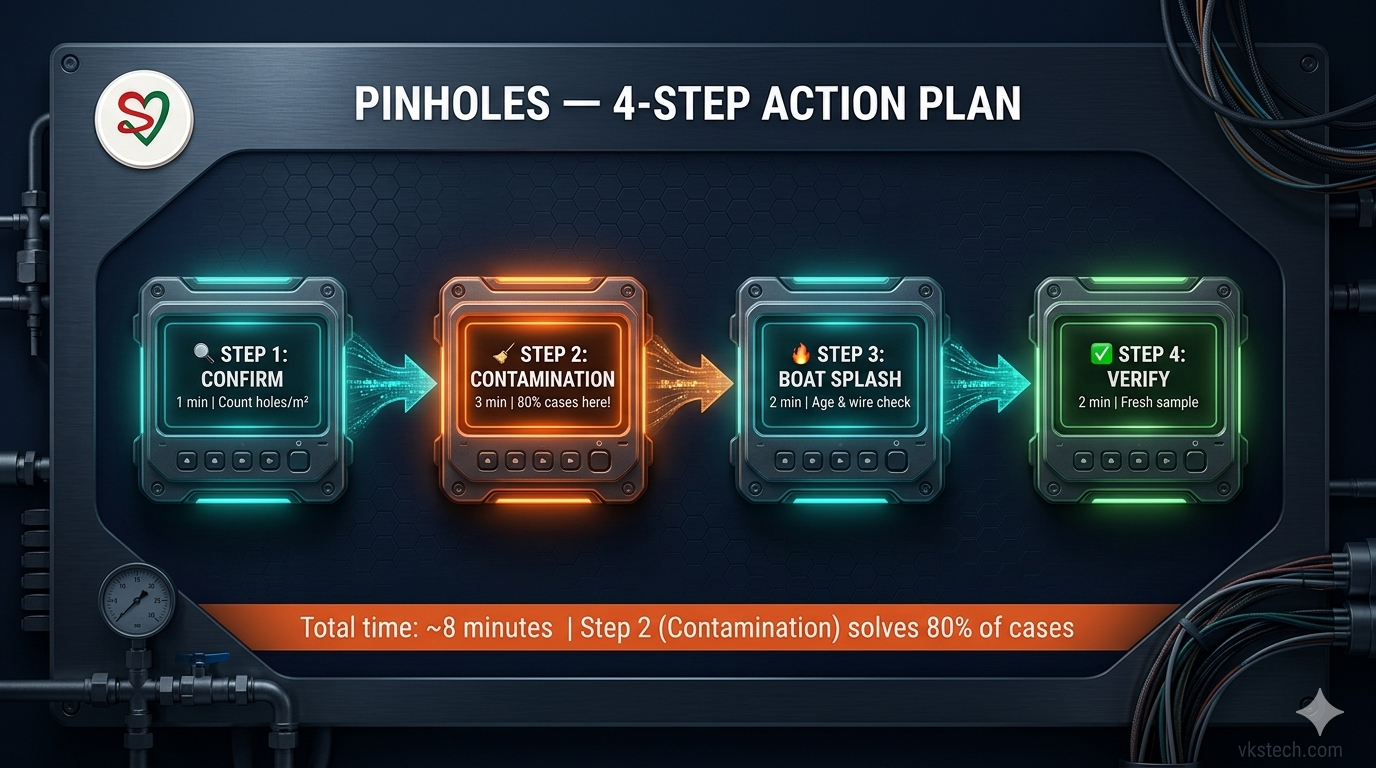
🎯 The 4-Step Pinhole Action Plan
| Step | Action | Time | Tools Needed |
|---|---|---|---|
| 1. Confirm | Count holes/m², check pattern | 1 min | Tracker lightbox |
| 2. Contamination Check | Rollers, shields, unwind roll | 3 min | Torch + IPA + cloth |
| 3. Boat Splash Check | Boat age, wire quality, feed rate | 2 min | Viewing window + HMI |
| 4. Verify | New sample after fix, recount | 2 min | Tracker lightbox |
🔍 Step 1 — CONFIRM (1 minute)
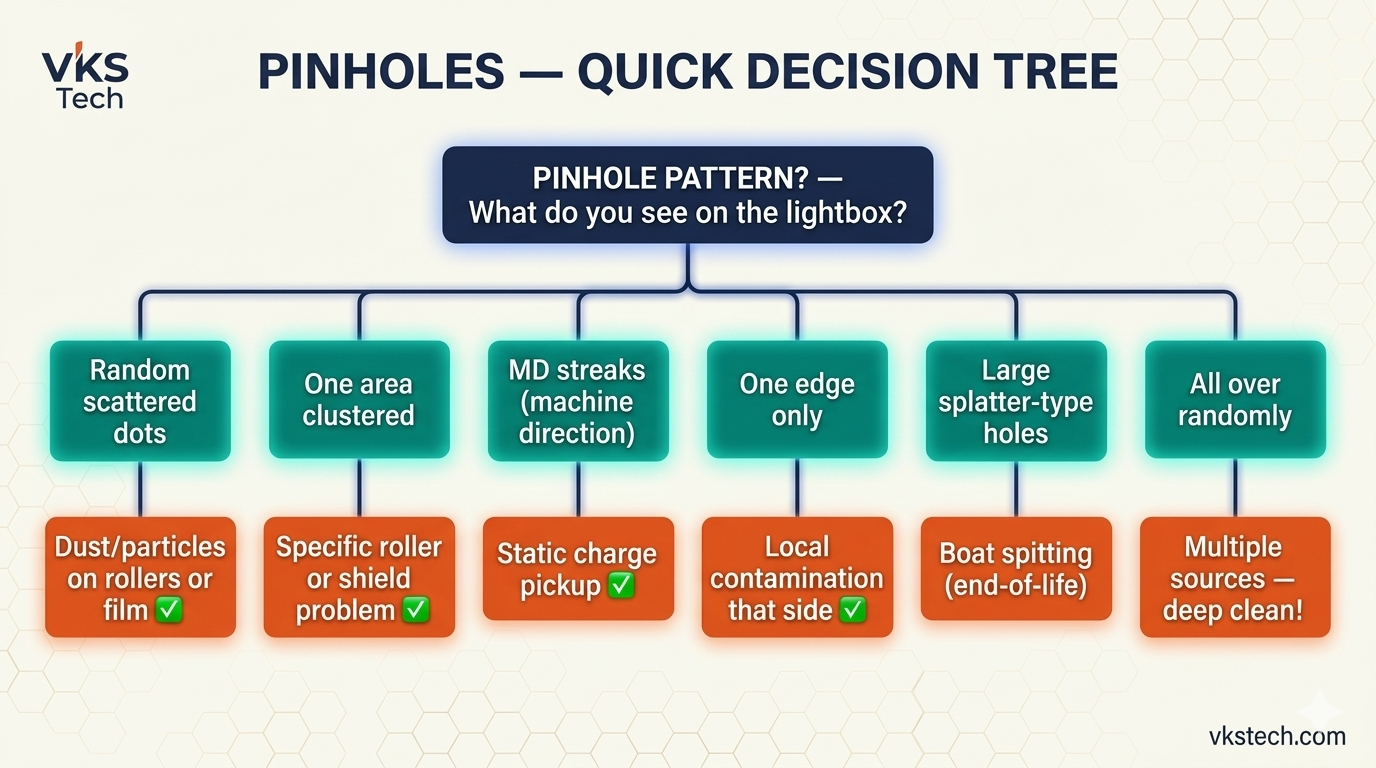
Before adjusting anything, diagnose the pinholes properly. Not all pinholes are caused by the same thing:
- Random scattered dots → Most likely dust/contamination on rollers or film
- Clustered in one area → Specific roller or shield problem
- Streaks along machine direction → Static charge picking up particles
- Mainly at one edge → Local contamination on that side only
- Large splatter-type holes → Boat spitting (end-of-life)
Use the inspection lightbox properly: strobe mode is best for counting, steady light for pattern recognition. Count holes per square metre and compare with your customer spec (typical: <10 pinholes/m² for food packaging, <25/m² for industrial).
🧹 Step 2 — CONTAMINATION CHECK (80% of cases!)
This is the single biggest cause of pinholes. Every particle that lands on the film surface before metallization creates a pinhole. Check in this order:
| Check | Symptom | Fix |
|---|---|---|
| Guide rollers | Visible dust/deposit on roller surface | Wipe with IPA + lint-free cloth |
| Unwind roll edges | Dust from handling or storage | Return roll, use clean stock |
| Coating shields | Previous deposit flaking off | Remove, sandblast, reinstall |
| Chamber walls | Aluminium particles loose | Vacuum clean during PM |
| Static discharge | Anti-static bar not working | Clean/replace bar, check power |

🔥 Step 3 — BOAT SPLASH CHECK (2 minutes)
When contamination is ruled out, the next culprit is the boat itself. An aging or overworked boat starts "spitting" molten aluminium droplets that land on the film surface and create larger splatter-type pinholes:
- Boat age: Any boat past 70% of life cycle is prone to spitting — check usage log
- Wire feed rate too high: Overfeeding causes molten pool instability → splatter
- Oxidized wire: Old or exposed wire spools create irregular evaporation → spitting
- Uneven boat temperature: Hot spots from dirty copper contacts → splash
- Excessive OD target: Running OD 2.8+ on aged boats is asking for splash
Look through the viewing window during run (with UV-rated PPE). Healthy boats glow uniformly red-orange. Spitting boats show bright flashes, flickers, or visible droplet trajectories toward the drum.
✅ Step 4 — VERIFY
After applying the fix, don't just assume it's solved. Pinholes are sneaky:
- Run for 100 metres at normal production speed
- Take fresh sample from current production (not the post-fix changeover zone)
- Inspect on Tracker lightbox — count pinholes/m²
- Below customer spec? → Continue production
- Still high? → Go back to Step 2 (you missed a contamination source)
🏭 Real Shop Floor Story — The ₹3.2 Lakh Customer Rejection
Met-1, morning shift, Monday. A major snack brand had just called — 3 full jumbos of 12-micron metallized PET rejected. Reason: pinholes above spec. Customer sent photos showing 40-60 pinholes per m² on their lightbox. Our inline QC had recorded <15/m². How did this happen?
Production engineer called an emergency investigation. Initial suspicion: boat splash. Boat usage log showed they were at 55% life — not aging. Wire spool was fresh. Recipe was standard OD 2.3. Nothing obvious.
Then someone asked: "Humne rollers kab clean kiye the?" Silence. The weekly cleaning schedule showed last cleaning was 9 days ago — Sunday before last. Weekend skeleton crew had skipped it. Monday's shift was on a tight deadline, nobody stopped to do it.
Rollers were opened. Guide roller #4, just before the coating zone, had a thin powdery film of condensed aluminium and film particles. Under the lightbox, this same roller's contamination pattern matched exactly where customer photos showed pinhole clusters. The rejected 3 jumbos = 18,000 metres of film = ₹3.2 lakh in lost A-Grade revenue + rework cost.
The plant now enforces an "Every-48-Hour Rule": Guide rollers 3, 4, and 5 (the ones just before the coating zone) must be IPA-wiped every 48 hours maximum — no matter what. A small green sticker on each of these rollers gets updated with the last-cleaned date. Operators can't start a jumbo if any sticker is past 48 hours.
Lesson: Pinholes are not a machine problem — they're a discipline problem. The ₹3.2 lakh rejection taught the plant that inline sensors only catch some defects. What the customer sees on THEIR lightbox matters more than what yours shows. Every skipped cleaning is a silent timer running toward the next rejection call.
📊 Top 5 Causes of Pinholes — Ranked by Frequency
| Rank | Cause | Frequency | First Action |
|---|---|---|---|
| #1 | Dirty guide rollers (before coating zone) | ~45% | IPA clean all rollers |
| #2 | Boat spitting (end of life or overfeeding) | ~20% | Check boat age + wire feed |
| #3 | Shield deposit flaking | ~15% | Clean/replace shields |
| #4 | Unwind roll contamination | ~12% | Check roll quality at receipt |
| #5 | Static pickup + poor anti-static | ~8% | Service anti-static bars |
🛡️ Prevention — Stop Pinholes Before They Start
- Every-48-Hour Rule: Guide rollers 3-5 (just before coating) wiped with IPA every 48 hours maximum
- Weekly chamber vacuum: Remove loose particles from shields and chamber walls
- Boat retirement at 80% life: Don't push boats to end-of-life for high-value customers
- Wire spool storage: Keep unused spools in sealed bags, rotate FIFO
- Incoming roll check: Every unwind roll inspected for dust/damage before mounting
- Anti-static bars: Monthly cleaning + function check (use static meter)
📥 Free Downloads — Take This to the Shop Floor
Two professionally designed PDFs for immediate plant use. Print, laminate, and use during real defects:
🔵 Pinholes — Barrier को ख़त्म कर देने वाला डिफेक्ट
Sample roll को Tracker inspection light पर रखते हो, और पार से छोटे-छोटे चमकते dots दिखाई देते हैं — जैसे रात के आसमान में तारे। हर एक dot एक pinhole है — aluminium coating में microscopic failure जो oxygen और moisture को सीधा पार जाने देती है। आपकी "high-barrier" metallized film अब सिर्फ़ transparent plastic बन गई।
Pinholes वह #1 कारण हैं जिनकी वजह से customers metallized jumbos "REJECT" marked वापस भेजते हैं। OD defects के उलट जो sensor screen पर दिखते हैं, pinholes चुपचाप बनते रहते हैं — lightbox पर sample आने तक। और तब तक कई बार 100-200 metres film wind हो चुकी होती है। यह blog आपको वह 4-step action plan देता है जो pinholes जल्दी पकड़ता है — और वह shop floor कहानी भी जिसने एक plant का roller cleaning approach हमेशा के लिए बदल दिया।
⚠️ Pinholes इतने ख़तरनाक क्यों हैं
- Barrier destroy: सिर्फ़ 5 pinholes/m² भी WVTR को 0.5 g/m²/day से बढ़ाकर 15 g/m²/day कर देते हैं — 30x barrier failure
- Customer rejection: Food packaging brands की zero tolerance — lightbox पर एक pinhole = पूरा jumbo reject
- देर से पता: Inline sensor पर नहीं दिखते, सिर्फ़ QC lightbox पर पकड़ में आते हैं
- महँगा re-work: Best case B-Grade, अक्सर full scrap = सीधा P&L नुकसान
- Reputation damage: एक customer की pinhole complaint पूरे industry में फैलती है
🎯 4-Step Pinhole Action Plan
| Step | Action | Time | ज़रूरी Tools |
|---|---|---|---|
| 1. Confirm | Holes/m² count, pattern check | 1 min | Tracker lightbox |
| 2. Contamination Check | Rollers, shields, unwind roll | 3 min | Torch + IPA + cloth |
| 3. Boat Splash Check | Boat age, wire quality, feed rate | 2 min | Viewing window + HMI |
| 4. Verify | Fix के बाद नया sample, फिर count | 2 min | Tracker lightbox |

🔍 Step 1 — CONFIRM (1 मिनट)
कुछ भी adjust करने से पहले pinholes को ठीक से diagnose करो। सभी pinholes एक जैसे कारण से नहीं आते:
- Random scattered dots → सबसे ज़्यादा संभावना: roller या film पर dust/contamination
- एक area में clustered → Specific roller या shield problem
- Machine direction में streaks → Static charge particles उठा रही है
- सिर्फ़ एक edge पर → उस side पर local contamination
- बड़े splatter-type holes → Boat spitting (end-of-life)
Inspection lightbox सही से use करो: Strobe mode counting के लिए best, Steady light pattern देखने के लिए। Holes प्रति square metre count करो और customer spec से compare करो (typical: food packaging के लिए <10 pinholes/m², industrial के लिए <25/m²)।
🧹 Step 2 — CONTAMINATION CHECK (80% मामले!)
यह pinholes का सबसे बड़ा कारण है। हर वो particle जो metallization से पहले film surface पर बैठता है, एक pinhole बनाता है। इस order में check करो:
| Check | Symptom | Fix |
|---|---|---|
| Guide rollers | Roller surface पर visible dust/deposit | IPA + lint-free cloth से wipe करो |
| Unwind roll edges | Handling या storage से dust | Roll वापस भेजो, clean stock use करो |
| Coating shields | पुराना deposit flake हो रहा | निकालो, sandblast, reinstall |
| Chamber walls | Aluminium particles loose | PM में vacuum clean |
| Static discharge | Anti-static bar काम नहीं कर रहा | Bar साफ/बदलो, power check |

🔥 Step 3 — BOAT SPLASH CHECK (2 मिनट)
जब contamination rule out हो जाए, तो अगला culprit boat ख़ुद होता है। पुराना या ज़्यादा load wala boat "spitting" करना शुरू कर देता है — molten aluminium droplets film surface पर बैठकर बड़े splatter-type pinholes बनाते हैं:
- Boat age: 70% life cycle के बाद कोई भी boat spitting कर सकता है — usage log check करो
- Wire feed rate ज़्यादा: Overfeeding से molten pool instability → splatter
- Oxidized wire: पुराना या exposed wire spool irregular evaporation करता है → spitting
- Uneven boat temperature: गंदे copper contacts से hot spots → splash
- ज़्यादा OD target: पुराने boats पर OD 2.8+ चलाना splash को invite करना है
Run के दौरान viewing window से देखो (UV-rated PPE के साथ)। Healthy boats uniform red-orange glow करते हैं। Spitting boats bright flashes, flickers, या droplet trajectories drum की तरफ दिखाते हैं।
✅ Step 4 — VERIFY
Fix apply करने के बाद solved मान मत लो। Pinholes धोखा देते हैं:
- Normal production speed पर 100 metres चलाओ
- Current production से fresh sample लो (post-fix changeover zone से नहीं)
- Tracker lightbox पर inspect करो — pinholes/m² count करो
- Customer spec से कम? → Production continue
- अभी भी ज़्यादा? → Step 2 वापस जाओ (कोई contamination source छूट गई)

🏭 असली Shop Floor कहानी — वो ₹3.2 लाख की Customer Rejection
Met-1, सुबह की शिफ्ट, सोमवार। एक बड़े snack brand का call आया — 12-micron metallized PET के 3 पूरे jumbos reject। कारण: pinholes spec से ज़्यादा। Customer ने photos भेजे जिनमें 40-60 pinholes/m² उनके lightbox पर दिख रहे थे। हमारे inline QC में <15/m² record थे। यह कैसे हुआ?
Production engineer ने emergency investigation बुलाई। पहला शक: boat splash। Boat usage log 55% life पर था — पुराना नहीं। Wire spool fresh था। Recipe standard OD 2.3। कुछ obvious नहीं।
फिर किसी ने पूछा: "हमने rollers कब clean किए थे?" चुप्पी छा गई। Weekly cleaning schedule दिखा कि आख़िरी cleaning 9 दिन पहले हुई थी — पिछले रविवार। Weekend की skeleton crew ने skip कर दिया था। सोमवार की shift tight deadline पर थी, किसी ने रुककर नहीं किया।
Rollers खोले गए। Guide roller #4, coating zone से just पहले वाला, पर condensed aluminium और film particles की patli powdery film थी। Lightbox के नीचे, इसी roller की contamination pattern बिल्कुल customer photos में दिखे pinhole clusters से match कर रही थी। Reject हुए 3 jumbos = 18,000 metres film = ₹3.2 लाख की A-Grade revenue loss + rework cost।
अब plant में "हर-48-घंटे नियम" enforce किया जाता है: Guide rollers 3, 4, और 5 (coating zone से just पहले वाले) को maximum 48 घंटों में एक बार IPA-wipe करना ज़रूरी है — कुछ भी हो। हर roller पर एक छोटा green sticker है जिस पर last-cleaned date update होती है। अगर कोई sticker 48 घंटे से पुराना है, तो operator jumbo start नहीं कर सकता।
सीख: Pinholes machine problem नहीं — discipline problem हैं। ₹3.2 लाख की rejection ने plant को सिखाया कि inline sensors सिर्फ़ कुछ defects पकड़ते हैं। जो customer अपने lightbox पर देखता है वो ज़्यादा मायने रखता है। हर skipped cleaning एक silent timer है जो अगली rejection call की तरफ़ चल रहा है।
📊 Pinholes के Top 5 कारण — Frequency Ranked
| Rank | कारण | Frequency | पहली Action |
|---|---|---|---|
| #1 | गंदे guide rollers (coating zone से पहले) | ~45% | सभी rollers IPA से साफ |
| #2 | Boat spitting (end of life/overfeeding) | ~20% | Boat age + wire feed check |
| #3 | Shield deposit flaking | ~15% | Shields साफ/बदलो |
| #4 | Unwind roll contamination | ~12% | Receipt पर roll quality check |
| #5 | Static pickup + ख़राब anti-static | ~8% | Anti-static bars service |
🛡️ Prevention — Pinholes आने से पहले रोको
- हर-48-घंटे नियम: Guide rollers 3-5 (coating से पहले) maximum 48 घंटे में IPA-wipe
- Weekly chamber vacuum: Shields और chamber walls से loose particles हटाओ
- 80% life पर boat retirement: High-value customers के लिए boats को end-of-life तक मत धकेलो
- Wire spool storage: Unused spools sealed bags में रखो, FIFO rotate
- Incoming roll check: हर unwind roll को mounting से पहले dust/damage के लिए inspect
- Anti-static bars: Monthly cleaning + function check (static meter use करो)
📥 मुफ़्त Downloads — Shop Floor पर ले जाओ
दो professionally designed PDFs जो plant में तुरंत इस्तेमाल हो सकते हैं। Print करो, laminate करो, real defects में use करो: